
By Carolyn Sharpe, Woodstock, IL
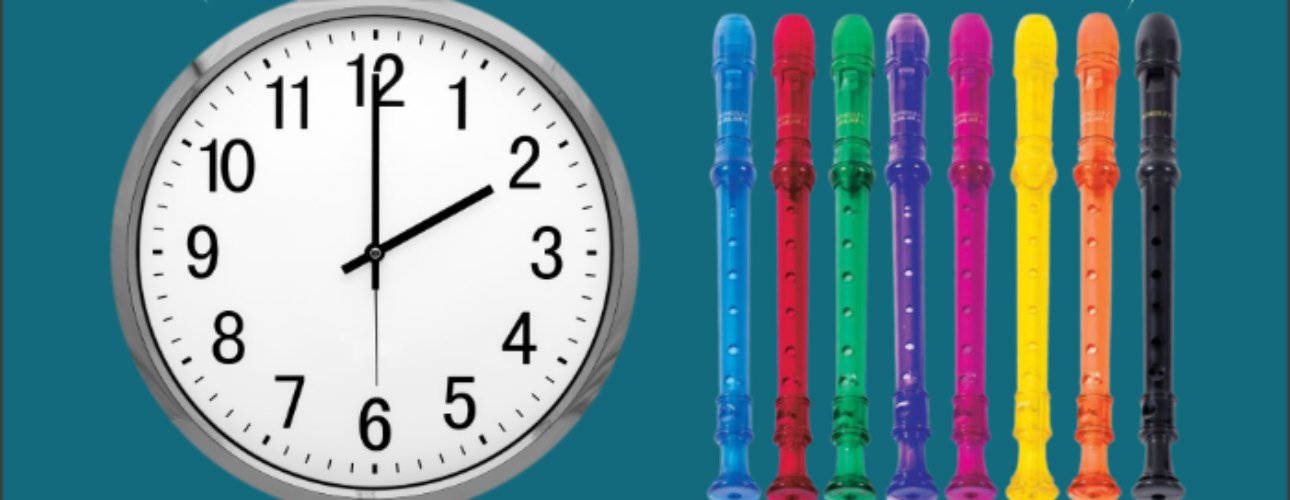
One of the most stunning realizations I have ever made in my teaching career is that I have only a maximum of 36 hours a year to teach music to my students! I have always had the fairly typical situation of teaching my classes for 30 minutes twice a week. Some teachers have even less time and some very fortunate teachers have a bit more, but it’s rare that any of us would say we have “enough”. Consider a particular class that doesn’t meet on Mondays or Fridays and misses multiple days. Even if the class doesn’t miss any meetings due to field trips and the students all have perfect attendance, we still only have 36 hours! In light of that, I realized that the routines I use to keep things running smoothly and efficiently are incredibly important.
For most of us, the first day of teaching recorder is like a secondary first day of school. It’s another opportunity to create a framework for smooth routines and a good use of time. I have used the Kingsley Recorders from Macie Publishing for many years now, and the cases they arrive in are in themselves a great tool for keeping things running smoothly! I always write the students’ names on the cases with a Sharpie or paint pen before they enter the classroom. These cases stand the test of time (and the carelessness that often accompanies 8-10 years olds!). Each student is also told to keep their recorder in the case in their backpack. I want them to take those recorders home, and I want them to remember to bring them back on the right day, but that’s really hard! Many schools have a rotation rather than a specific day of the week schedule, but either way, I think the best solution is to tell students to take their recorder home and practice, but to make sure to put it back in their backpack when they’re done practicing. The recorders themselves are so durable, that in over twenty years of using them, I’ve never once had a student break their recorder from keeping it and their lunch, water bottle, and books in their backpack.
On that first day of recorder I also put the neck straps on the recorders for the students. If you’ve never tried using the neck straps, it’s a tool I highly recommend! First, they give another way to identify whose recorder is whose. Once students have chosen their particular color recorder, they can also choose their own color neck straps. Lots of students enjoy combining colors to represent their favorite sports teams. There are so many ways to use the neck straps for identification and for grouping purposes. For example, you could have everyone with a red neck strap play B, everyone with a green neck strap play G, and everyone with a blue neck strap play D and create the magic of a major chord! The possibilities are endless.
Hands down though, my favorite benefit of the neck straps is that everyone has their recorder when it’s time to pick them up. Before I started using neck straps, there was always a recorder or two that went rolling around the floor, creating a clatter and a little bit of a delay while the student retrieved it. They are a fabulous time-saver so that we can go smoothly from playing to standing to moving and back to sitting and playing without the delay of picking our materials back up. The neck strap is an excellent tool for managing any hands-free activity including playing ORFF instruments and non-pitched percussion instruments. The neck straps also become the foundation for displaying the rewards they can earn in the Be a Recorder Star Reward Program.
I am a strong believer in every student having a physical copy of the book to use, and in class I love using the online version of Be A Recorder Star (student codes are also available). I am able to quickly and efficiently get everyone on the right page because it’s projected on the whiteboard! If every student is looking for the page they’re supposed to be on, a good deal of time is spent waiting for that to happen. With the online learning platform, that process is streamlined, but it also facilitates the opportunity for so much teacher modeling and interacting with notation. I use the board to project and focus student attention on the visual aspects of notation. I always like to joke with my students that I want them to learn to read music so that they don’t need me to come over for dinner every night to help them practice. Having the notation in a central place in the classroom can help them to crack the code of music notation as we use it day by day to teach them and model good habits like circling tricky parts, writing in counting, etc. If your white board has a stylus, you can have students come up to the board to perform activities. The online book on the screen quite literally keeps us all on the same page!
Another aspect of routine that helps to maximize our time is to have a predictable flow to each class. Although the elements within the lesson might vary greatly from day to day, the students will know that when they come in that they should sit in their assigned seats, get the recorders out and put them around their necks, and sit in a way that shows they are ready for the first direction. While we move from activity to activity during the lesson, I give as many directions as possible without speaking. I have a hand signal to stand and to sit and I use hand signals to direct attention to the board or to another spot in the room like a fingering chart or poster on notation. The more directions you can give non-verbally, the better! Even quieting the class down can be done with as simple a gesture as looking at the clock. This is one of my favorite techniques because it usually leads to the class reminding each other.
With careful attention to our routines, we can make the most of our valuable time with our students. As music educators we have the gift of teaching one of the most joyful, universal, and beautiful parts of being a human. It’s worth our effort to make the most of every minute we have for giving this gift to our students.
SHARE POST
