By Dr. Ran Whitley
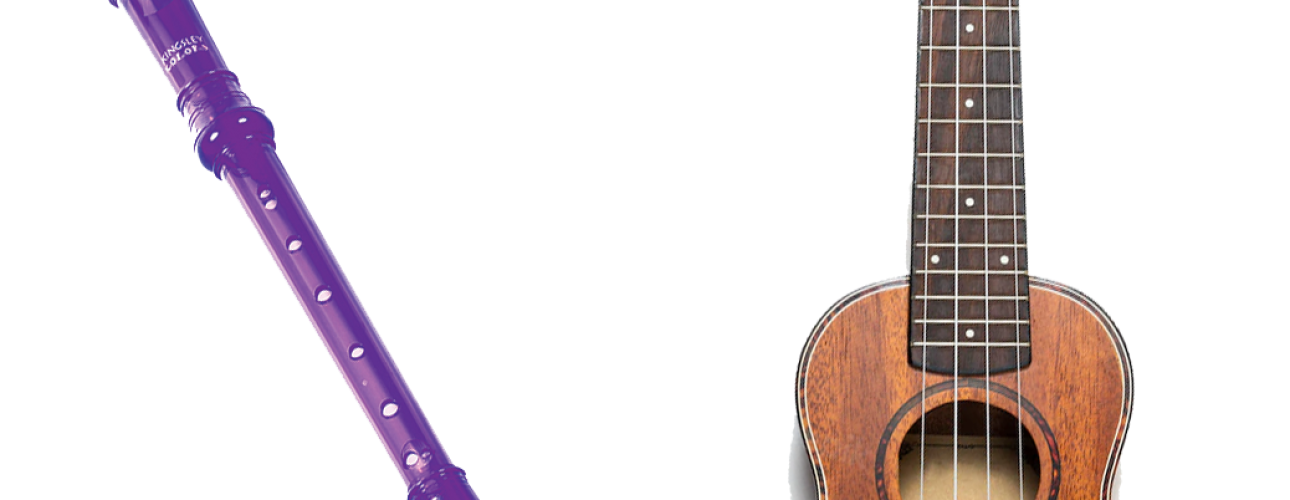
Recorders, what’s not to love? From “Hot Cross Buns” to Beethoven’s “Ode to Joy,” children can experience the pure delight of making melody to fun pop tunes as well as great symphonic classics.
Ukuleles, what’s not to love? With only three or four chords, children can also play along harmonically with fun pop tunes as well as great symphonic classics.
In recent years, however, some teachers are opting for ukuleles alone while abandoning recorders without considering what the children would be missing. Let’s discuss the additional benefits offered by recorders:
- Recorders teach notation while ukuleles do not. Ukulele instruction only requires a chord name. Chord names alone do not teach the children which notes are found in each chord, or where those notes are located on the staff. The acquisition of note names is absolutely required to play recorder, and recorder instruction teaches note names and pitch most effectively.
- Recorders teach rhythm while ukuleles do not. Ukuleles do require a basic repeated rhythmic strum pattern, but generally only one pattern is used per song and the patterns are generally taught by rote. The acquisition of rhythmic literacy is absolutely required to play recorder as each measure may be rhythmically varied or distinct. Ukulele instruction does not guide children to rhythmic literacy. Recorder instruction does.
- Recorder instruction prepares children to play band and orchestral instrument. Ukuleles do not. Children who have good recorder instruction learn pitch, rhythm, expression and ensemble. These important foundational skills translate immediately to band and orchestra instruments. Also applicable to band instruments, recorders teach the important concepts of breath control, tone production and intonation. Ukuleles do not. Furthermore, the fingerings for recorder are the basis for all woodwind instrument fingerings. Children who can play recorder find the fingerings for sax, flute and clarinet to be effortless.
- Recorders are much less expensive, are a fraction of the cost of ukuleles and require no maintenance or string replacement. Tuning ukuleles takes additional class time. Also, the children may not take the ukulele home, but they may keep their recorder for life.
- Frankly stated, the ukulele is easy to play and allows almost instant success on the instrument. This is important because as children obtain the ability to play ukulele quickly, they are having fun and acquiring positive attitudes toward music. Recorders on the other hand require discipline of practice and critical self-evaluation. Discipline is an important instructional outcome in the in development of the whole child. Where else except in music can children best learn discipline? Acquisition of recorder technique teaches discipline. And the discipline that children learn through music will serve them well in other academic areas as well as later throughout their lives.
So, let’s not ask the question, “Recorders or Ukuleles?” Rather, let’s say, “Recorders and Ukuleles.” Between the two we can cover harmony, melody, rhythm, ensemble, expression and the sheer joy of making music.
Remember the words of Plato regarding both melody (recorders) and harmony (ukuleles). “Familiarize children’s minds with rhythms and melodies, thus making them more civilized, more balanced, better adjusted in themselves, and more capable in whatever they say or do, for melody and harmony are essential to the whole of life.”
Ran Whitley, DM, PhD
Professor of Music Education
Campbell University